British Physics Olympiad
Every year, the British Physics Olympiad holds a series of competitions, allowing students around the UK to test their ability in physics, as well as introduce new ways of tackling problems that would not be commonly seen in GCSEs or A Levels. This year, the BPhO introduced a new round - Round 0, to narrow down competition for the further stages. In Wilson’s, 25 of us took part, of whom 19 qualified for Round 1; especially well done to the four Year 12s who, despite not being familiar with as much of the content, still managed to come in the top 1,800 of the 9,000 exceptionally able physicists who took part. Round 0 was an interesting paper - because it was new, it was tough for us to anticipate what could come up and there were some intriguing problems that certainly left us wondering how to go about it. A month later, we took part in Round 1. Though not as tough as some of the later papers, there was certainly some difficulty as well as time pressure to this paper. When I did it, I just tried to enjoy the paper, and pace myself so that I wasn't rushing - it was quite a fun experience, especially with some of the section 1 questions showing niche symmetries or methods that you had to look out for. The second section of the paper contained a few longer answer questions, being much more heavy on calculus, applying areas of maths to physics we had not seen before in the A-level. A few of us also decided to take part in the first round of the British Astronomy and Astrophysics Olympiad (BAAO) - the astro side of the competition. This used new concepts which we were not as practiced with, such as absolute and apparent magnitudes (measures of brightness of faraway stars), and the use of parallax to measure distance. The astro paper was much more difficult than the physics one (though still an intriguing challenge!) - I certainly remember feeling totally lost on a lot of the parts in the second section of the paper, having to scrounge around for whatever marks I could find.
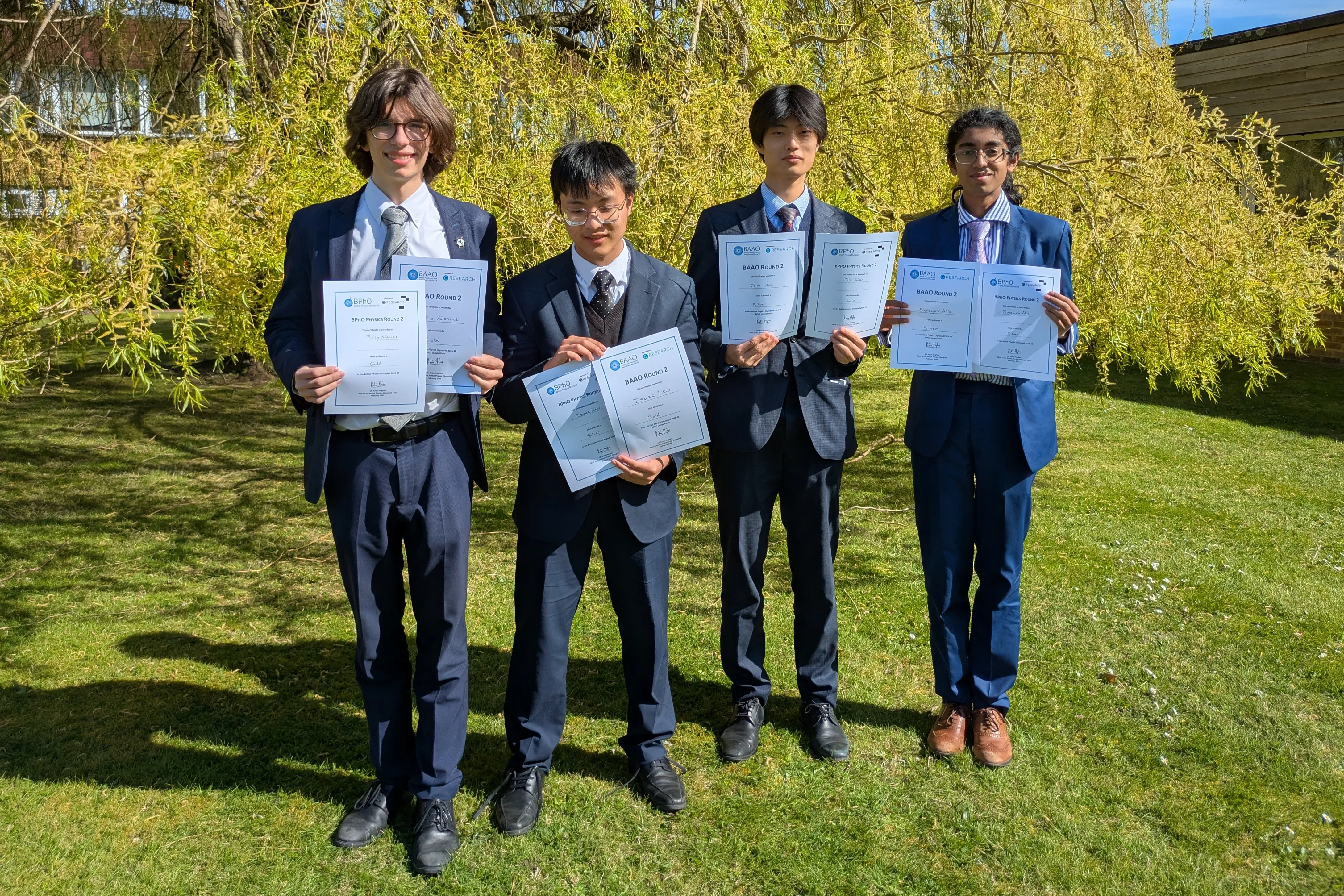
Just before the Christmas break, we received our results - on the physics side, Olin, Isaac, Shreyas and I (all Year 13) achieved a Top Gold, placing us in approximately the top 100 of the competition and qualifying us to the second rounds of the BPhO and BAAO. On the astro side, I got a Top Gold. I would also like to congratulate Egemen and Jamie (both Year 12), for scoring a Silver award in the physics side, and a Gold award on the astro side respectively, which was very impressive, considering they had not been exposed to most of this content before.
The Round 2 exams were on a new level compared to previous papers. Both the physics and astro papers were 3 hours long, containing just a few questions in each paper. They were all difficult, forcing us to reach into the depths of our physics knowledge to answer them. Though again, the astro side was much more challenging due to the unfamiliar topics introduced, I strangely found it slightly more enjoyable - perhaps it was because I was not expecting as much out of it, since I had not prepared so much, but the topics shown were still cool to understand. I particularly enjoyed the last question: the first part showing how we could use coordinate geometry and vectors to determine the angle a satellite dish would point in Cardiff, so that it could receive signals from some geostationary satellite elsewhere. It felt very unique, because I'd never seen an application of vectors and planes like that in any previous Olympiad questions before. Although it was very difficult, it was certainly a satisfying challenge to work through.
A few weeks later, we found out that on the physics paper, Isaac and Shreyas had achieved a Silver award, and Olin and I received a Gold award. On the astro paper, Olin and Shreyas scored a Silver award, and Isaac and I got a Gold. Furthermore, Isaac and I were invited to training camps at Oxford for astro and physics respectively, placing us in the top 14 physicists of the BAAO and BPhO Round 2s. These are to take place in Easter, and from what I've heard they are to be extremely intense. However, it is still an experience that I have not had before, and an extremely amazing opportunity to be offered by the BPhO, so I will be looking forward to it. I'd also like to celebrate how well the four of us have performed in the BPhO rounds this year, all placing in the top 60 nationally in the second round of the physics side, and top 40 for the second round of the astro side. I believe this is the best Wilson's has ever done in this Olympiad, and I am super proud to have contributed to it. Isaac and I also now make a total of 8 Wilsonians in the past 6 years to have made it to the Easter Camps, this also being the second time in Wilson's history where two people from the year have made it to this stage. I really am proud of our year for making it this far, and I hope we can serve as an inspiration for the brilliant years below in the future BPhO rounds.
Speaking of those in lower years in the school, there have also been some other physics competitions going on in this school. Recently, 86 students have sat the Y11 Intermediate Physics Challenge, and 69 students the Y12 Senior Physics Challenge. Both are difficult challenges, testing and stretching one's physics knowledge, and I hope everyone partaking in it enjoyed the tough problems, making them all better physicists by pushing themselves to understand these tough concepts.
All in all, the BPhO has been an incredible opportunity to take part in. It made everyone involved a better physicist at the end of it, and I am grateful to our teachers for allowing us to challenge ourselves in it."
Article written by Philip (Year 13)
Mr Benn commented:
This really is an outstanding achievement – two Wilson’s students are now in the final selection stage to represent Britain internationally.
This is the eighth time in seven years we have had students reach this stage. Prior to that, I can only find evidence of one student from the school ever to get so far.
We wish Philip and Isaac the very best at the Easter Camps, and congratulate them - and our other physicists - on their brilliant efforts thus far!