
Dr Cooper returns
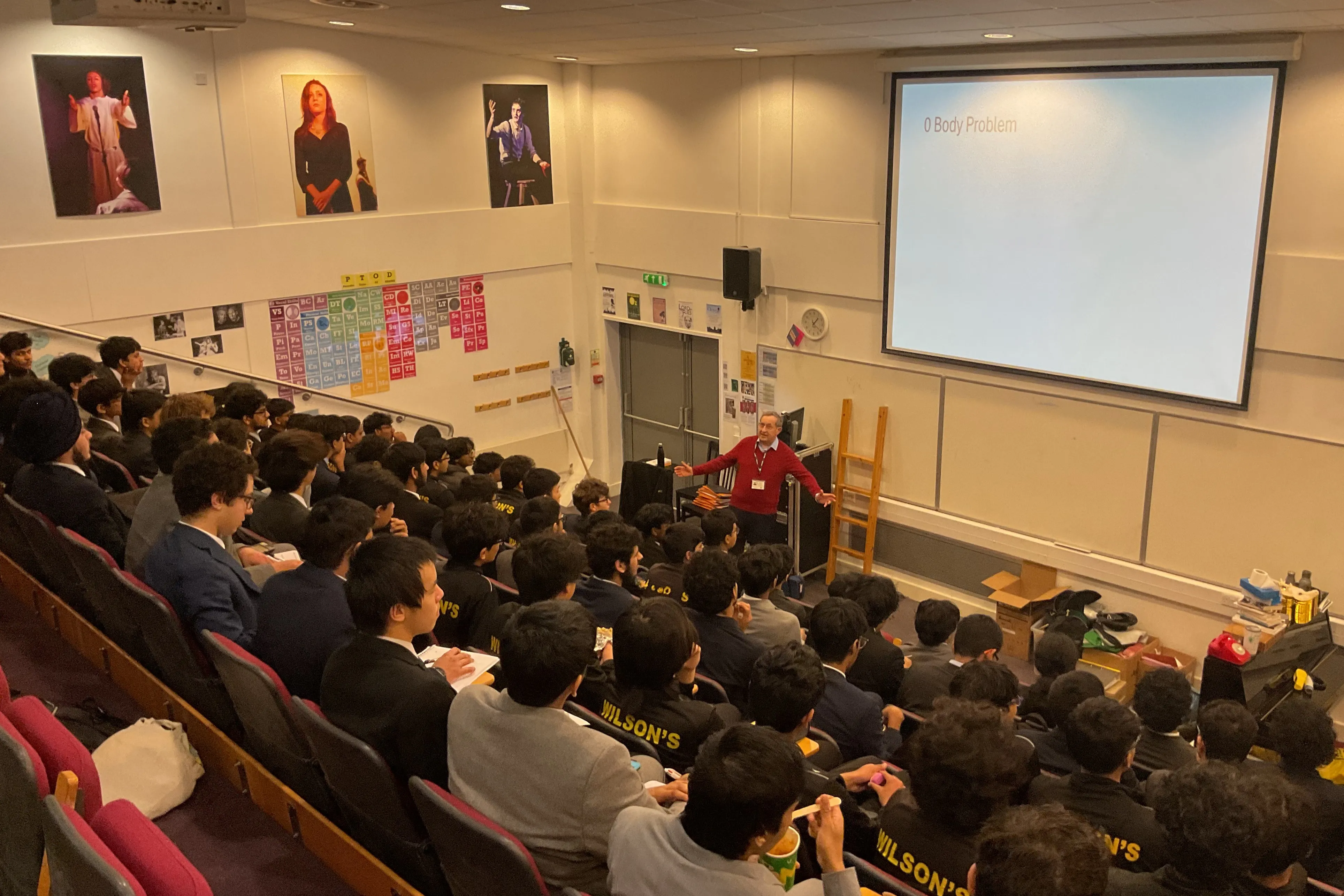
In the final week before the half term break, former teacher Dr Cooper returned to the school to give a fascinating talk on the three-body problem.
Connecting mathematics with physics, the talk began with explaining how mathematical modelling underpins much of the mechanics that occur around us, such as predicting the motion of objects in our universe using Newton’s gravitational laws.
The n-body problem in physics is a problem concerning the paths of celestial bodies in an orbital system that are directly affected by each other’s gravitational fields. He begins with a base case of 0 and 1 bodies, where the solution is trivial. With 2 bodies, the motions are still easy to model due to the simple two-way relationship between their motions. Increasing to 3 bodies however, the complexity rapidly escalates and likely creates a chaotic system where their motions must be simulated incrementally. The 4-body problem is sufficiently complex so as to allow no closed solution for any given position, that is, it cannot be generalised (even a small change in the position of one body could accumulate into drastic changes in the orbital paths of all the bodies).
Such problems are so renowned that Dr Cooper also mentioned The Three-Body Problem series on Netflix, a fictional world where Earth encounters an alien planet orbiting 3 suns (an example of the 3 body problem!), creating chaos and unpredictability in celestial motion, and consequently erratic and extreme weather on that planet
To put chaotic systems to application, he then gave us an interactive task to repeatedly input values into an iterative formula, with subsequent inputs into the same formula being the output of the previous iteration, beginning with an initial value and observing the behaviour of the sequence. One of the true wonders of the talk is experiencing the surprise when we tried formulae that were beyond a certain threshold. Some converged quickly to a certain value. Others took longer to converge, oscillating above and below a value, whilst some diverging completely without tending to a certain value. He also showed us an interesting remark, that with some iterative equations, a tiny adjustment in the initial value (sometimes related to rounding in a computer system) can lead to drastically different sequences many iterations in!
These chaotic systems have many real world applications, such as in modelling weather and creating forecasts, to predicting movements of markets in finance.
We thank you, Dr Cooper, for the enlightening talk!
Article written by Houting (Year 12)